12/15/10
Temple of Apollo
There are several Temples of Apollo from the ancient world. Three of the major temples are in Bassae, Pompeii, and Dephi. All of the temples were built in honor of Apollo, the Roman god of light and the sun.
In Bassae, Greece, the Temple of Apollo was built between 450 and 400 BC. The temple was built around the time of construction of the Parthenon in Athens (Hayes). The Temple of Apollo in Bassae was especially known for its isolated location on the side of a mountain and its unusual dedication (Image 1). One myth is that villagers from Figalos would travel to the Temple of Apollo in Bassae for protection from the plague and that they built the temple in gratitude for his help. Another myth about the Temple of Apollo in Bassae is that Apollo was considered the protector of the Arcadians, especially the mercenaries who were very wealthy. To thank Apollo for his help the mercenaries paid for the construction of the temple.
The temple combines Doric and Ionic orders (Image 8). The Corinthian capital is the oldest known example of this style in the ancient world. The style suggest that the design was from 450-440 BC with construction being completed in 425 BC. The temple was forgotten about and rediscovered in 1765 by accident when French architect, Joachim Bocher, stumbled upon it (Hayes).
This temple was preserved well because of its isolated location and provided historians with an image of what a temple looked like. The statues and other artifacts found in this temple helped to provide explanation for what happened within the temple. The style of the temple in Bassae also influenced the design of the other temples.
The Temple of Apollo in Pompeii was built in gratitude and in dedication to the Roman god Apollo. The original temple in Pompeii was built during the Samnite period and was modified under the emperor, Nero (Maiuri). The location of the temple requires visitors to enter from the Via Marina, the main road leading from Pompeii’s western entrance portal, that was built during the Samnite period (Image 2) (Temple of Apollo-Pompeii). The temple is located in an area of the forum that is enclosed by a portico of 48 columns (Maiuri).
The central column of the portico blocks the view of the temple from the forum. This suggests that the main entrance of the temple was once directly accessible from the forum (Temple of Apollo-Pompeii). The cella, or inner chamber of a temple, is raised on a high podium and surrounded by a Corinthian colonnade, which is 6 columns to the front (Maiuri). Leading up to the temple doors there are steps. At the foot of these steps a base made of travertine stands (Maiuri). Upon this travertine base stands an altar made of Greek marble. The altar was dedicated shortly after 80 AC by the quattorviri of Pompeii, Marcus Portius, Lucius Sestillus, Cneus Cornelius and Aulus Cornelius (Image 3) (Temple of Apollo-Pompeii). On one side of the temple there is a sundial that is placed upon a Phygian marble pillar (Image 4) (Maiuri).
The temple in Pompeii contains many statues of deities. Being a temple dedicated mainly to the god Apollo, there is a statue of him placed against the third column of the portico to the left (Image 5). On the right of the temple, facing the statue of Apollo is a bust of Diana, the goddess of the hunt who was commonly associated with wild animals (Image 6) (Maiuri). Diana is also Apollo’s twin sister. Both the statue of Apollo and the bust of Diana are represented as archers and are copies of the original statues found on the site of the temple (Maiuri). The temple had originally contained a statue of a divinity, according to writings, but that statue was never found. The temple also contained a rock of carved volcanic ash called tuff representing the world’s navel (Temple of Apollo-Pompeii). The carved volcanic rock in the temple is based on the original one located in the famous sanctuary of Apollo in Delphi, Greece (Temple of Apollo-Pompeii).
In Delphi, historians have discovered that the temple built there couldn't have been built before 750 BCE (Image 7) (Bremmer). The Temple of Apollo was the center of oracular activities in Delphi. In order to consult the oracle for answers one had to follow several steps. First they would have to make various sacrifices to the gods on a sacred altar. Then they would have to enter the temple of Apollo to present their question to the priestess of Apollo. The question could be presented either orally or written on a tablet. The priestess of Apollo, the Pythia, was said to be the bride of Apollo. She was an older woman and her age made it socially acceptable for her to mix in the company of men such as priests and ambassadors (Bremmer). Pythia would then present the answer from the gods to the questions that were presented to her.
All three temples show how the ancient Romans honored the god, Apollo. They each have their own style and reason for being built, but they all have a similar dedication. The Temple of Apollo was usually located in the main forum of a town and was the center of worship and oracular activities. The reason for being located so close to the forum was so that the temple could be accessible very easily. The ruins of these temples allow us to understand what kind of art the Romans had and what kind of religious practices they participated in. The ancient Romans worshiped Apollo above any other god because he was thought of as important and had helped the people with their problems. The Temple of Apollo was a grand temple, but was also thought of as a part of their everyday life and was visited often to pray and worship.
Image 1. Temple of Apollo in Bassae

Image 2. Temple of Apollo in Pompeii location
 Image 3: Cella and altar in the Temple of Apollo in Pompeii

Image 4: sundial at the Temple of Apollo in Pompeii
 Image 5: statue of Apollo at Temple of Apollo in Pompeii

Image 6: bust of Diana at Temple of Apollo in Pompeii
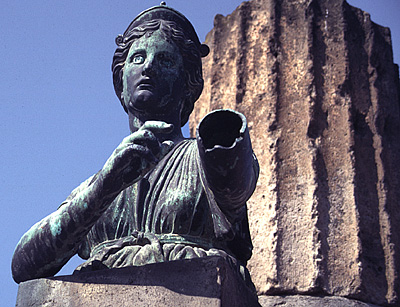
Image 7 Temple of Apollo at Delphi

Image 8 Temple of Apollo Bassae

